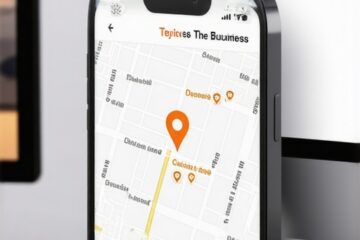
The Invisible Glitch in Your Business Profile Killing Local Mobile Leads
You log into your office computer, type your primary service into Google, and there you are – sitting comfortably in the top three of the local map pack. You breathe a sigh of relief, confident that your google business profile seo is firing on all cylinders. But then, you walk two blocks down the street to grab a coffee, perform the same search on your smartphone, and your business is nowhere to be found. You aren’t just lower in the rankings; you are invisible.
This is the “Invisible Glitch,” a phenomenon I have diagnosed for hundreds of clients as a local SEO consultant. In the world of modern search, a “verified” profile is not synonymous with a “visible” profile. Many business owners fall into the trap of trusting desktop results or static ranking reports that fail to account for the dynamic, hyper-local nature of mobile search. This discrepancy is more than a technical curiosity; it is a silent lead killer. With mobile searches for “near me” phrases increasing by over 250% in recent years, being invisible on mobile means you are effectively invisible to your most motivated customers.
In this guide, we will dissect why your profile might be ghosting your customers and how to implement a high-level google business profile optimization strategy that secures your position on the small screen. If you’ve ever wondered why your phone isn’t ringing despite a “green” status on your dashboard, you likely have a mobile-specific visibility gap. For a deeper dive into this specific technical failure, see my analysis on The Map Ranking Glitch That Only Shows Up on Mobile Devices.
Why Proximity is a Double-Edged Sword in 2026
Google’s local algorithm is built on three fundamental pillars: Relevance, Distance, and Prominence. While most SEO strategies focus heavily on relevance (keywords) and prominence (reviews and backlinks), the “Distance” factor has become increasingly volatile. In 2026, Google’s proximity filters are tighter than ever. We are seeing the rise of the “Proximity Cap,” a digital boundary that Google draws around a searcher’s real-time GPS coordinates.
The problem arises when Google detects inconsistencies in your data or a lack of mobile-specific engagement. When the algorithm lacks 100% confidence in your physical location or your relevance to a mobile user on the move, it shrinks your “visibility radius.” You might rank for someone standing 500 feet from your door, but someone a half-mile away – who is still well within your service area – sees your competitor instead. This is why a professional google maps ranking service is essential; it moves beyond basic keyword stuffing to address the algorithmic trust required to expand that radius.
Proximity is often a double-edged sword. While it protects you from distant competitors, it can also trap you in a tiny geographic bubble if your profile isn’t optimized for “Prominence.” If your competitors have stronger signals, Google will “reach” past your closer location to show a more prominent business further away. Understanding why proximity alone isn’t enough to beat better-optimized map competitors is the first step in reclaiming your local market share. Search queries for “repair near me” have grown by over 110%, and if you aren’t winning the proximity war, you are losing the highest-intent leads in your industry.
The Technical Friction Points: NAP and Schema
One of the primary reasons for the “Invisible Glitch” is technical friction. Google is an information engine that craves certainty. If there is even a 1% doubt regarding your business details, the algorithm will hedge its bets by demoting your profile in favor of a “safer” result. This brings us to the critical importance of NAP (Name, Address, Phone) consistency.
I often find that businesses have “ghost” data lingering from years ago. Perhaps a suite number was omitted on a Yelp listing, or a tracking number was used on a landing page without proper markup. These minor discrepancies trigger a “trust glitch.” Google’s crawlers see two different versions of your reality and, unable to reconcile them, they reduce your visibility. Data shows that 83% of U.S. shoppers conduct online research before visiting a store, and if their mobile search provides conflicting information, they simply move to the next listing.
To fix this, you must move beyond manual spreadsheets. Utilizing a robust google business profile audit tool can help identify these hidden discrepancies across the broader web. Furthermore, structured data (Schema markup) is no longer optional. Missing or broken structured data is consistently cited as one of the top 8 mistakes killing local SEO. By explicitly telling Google’s bots your exact latitude, longitude, and service hours through JSON-LD, you remove the guesswork. For a step-by-step technical walkthrough, refer to my guide on Fixing the Schema Errors That Kill Your Google Business Profile Impressions.
Ghost Listings and Duplicate Data Cannibalization
A hidden local SEO problem that many automated tools miss is the “Ghost Listing.” This occurs when an old version of your business – perhaps under a previous name or a former address – remains in Google’s index. Even if these listings are “unverified,” they act as a vacuum, siphoning off the authority and “Prominence” that should be flowing to your primary profile.
On mobile, where the screen real estate is limited to the “Map Pack” (the top three results), this cannibalization is devastating. Google may become “confused” as to which listing is the most relevant for a mobile user, and in its confusion, it may choose to show neither, or worse, show the old listing with an incorrect phone number. This creates a terrible user experience and a lost lead.
Cleaning up your digital footprint is a mandatory part of any effort to rank google business profile assets effectively. You must perform a deep-scan audit to identify these duplicates. Often, these ghost listings are created by third-party data aggregators who have outdated information. Identifying and merging these entities is a complex but necessary task. You can learn the manual process for this in my article on How to Spot and Remove Ghost Listings Hurting Your Map Ranking.
The 2026 Mobile Ranking Factors: Moving Beyond Keywords
As we move through 2026, the factors that influence your google business profile seo are shifting from static information to behavioral signals. Google is increasingly looking at how users interact with your profile on mobile devices. These “engagement signals” are the new currency of local search.
- Click-to-Call Rates: High volumes of mobile calls directly from the listing signal high relevance.
- Direction Requests: If users frequently ask for directions to your location from various points in the city, Google views your business as a “destination,” increasing your prominence.
- Photo Interaction: Profiles with high-quality, frequently updated photos (especially user-generated ones) see a significant boost in mobile visibility.
- Attribute Accuracy: Is your “Wheelchair Accessible” or “Outdoor Seating” tag accurate? Google uses crowdsourced data to verify this, and accuracy builds trust.
To stay ahead, you need to use local seo ranking tools that track these behavioral metrics, not just your position for a specific keyword. The goal is to prove to Google that your business is the most helpful answer to a user’s mobile query. Modern gmb ranking service providers now focus heavily on “Entity Strength” – how well your business is recognized as a real-world entity rather than just a collection of keywords. Prepare your business for these shifts by reading Preparing for the 2026 Local SEO Trends: Moving Beyond Basic Keywords.
The Manual Audit: Finding What Software Misses
Why do automated reports often show “green” while your phone stays silent? Most local seo tools use fixed IP addresses or simulated locations from a desktop environment. They don’t account for the “noise” of a real-world mobile environment – cell tower triangulation, moving GPS coordinates, and varying signal strengths.
To truly diagnose the “Invisible Glitch,” you must perform a manual audit. This involves searching for your business from at least five different physical locations within your target radius using a mobile device in incognito mode.
The 10-Minute Manual Check:
- Disable Wi-Fi on your phone to rely on cellular data.
- Open a private/incognito browser tab.
- Search for your primary keyword + “near me.”
- Note your position at your storefront, 1 mile North, 1 mile South, 1 mile East, and 1 mile West.
If you see wild fluctuations – ranking #1 at your door but disappearing entirely just a mile away – you have a proximity filter issue. This manual verification is the only way to catch the errors that even the most expensive software might overlook. For more advanced troubleshooting, I recommend using google maps performance tools to visualize your ranking grid. You can also follow my checklist: The 5-Minute Maps Check That Catches Errors Pro Software Misses.
Conclusion: Reclaim Your Mobile Visibility
In the competitive landscape of local search, you cannot afford to be a victim of the “Invisible Glitch.” A profile that looks perfect on a desktop but fails on mobile is a liability, not an asset. By focusing on the three pillars of google business profile optimization – technical accuracy (NAP and Schema), entity health (removing ghost listings), and behavioral engagement – you can ensure that your business remains visible exactly when and where your customers need you.
Don’t let a technical glitch hand your hard-earned leads to a competitor who simply has a cleaner data set. Whether you perform a manual audit today or hire a professional google maps ranking service, the time to act is now. Mobile intent is only going to grow, and the businesses that dominate the map pack in 2026 will be those that prioritize the mobile user experience above all else. If your rankings have dipped recently, start your recovery by reading How to Diagnose a Google Business Profile That Suddenly Stopped Ranking.
Your customers are out there, searching for you on their phones right now. Make sure they can find you.